Keeping your olla clean: algae, residue and unexpected guests
An olla only waters well if its clay walls stay open, and three things close them: light, residue and whatever falls in. Keep it covered, fill it with plain water, and it will keep feeding your plant for seasons.
The olla in every Vande Beejam grow bag is an unglazed clay pot from a local potter. It holds 2 to 3 litres and sits buried up to its neck, with only the mouth and lid showing above the mulch. Water seeps out through tiny pores in the clay, slowly, only as fast as the soil around it pulls it out. In most homes you need to refill it only every 15 days or so.
Those pores are the whole method. Everything below is about keeping them clear.
Light is what turns olla water green
When sunlight reaches the water inside an olla, algae start to grow. Water, warmth and light are all algae need, and an open olla on a sunny terrace gives them all three.
Within a couple of weeks the inside wall can turn green or feel slippery. That slime is a living film of algae and bacteria, and it sits right on the pores the water has to pass through. The olla starts emptying more slowly, the soil around it stays drier, and the plant gets less than it should. Often the water also begins to smell.
The fix is simple: keep the light out.
Keep the lid on, always
A well-fitting lid or cap blocks sunlight, and that alone stops most algae before it starts. It does three other jobs too:
- Keeps out mosquitoes. Open standing water is where mosquitoes breed, and an olla holds 2 to 3 litres of it for two weeks at a time.
- Keeps out debris. Leaves, mulch and soil that fall in rot in the water and add to the slime on the walls.
- Keeps out visitors. An open olla is a cool, damp hiding place, and garden creatures find it fast.
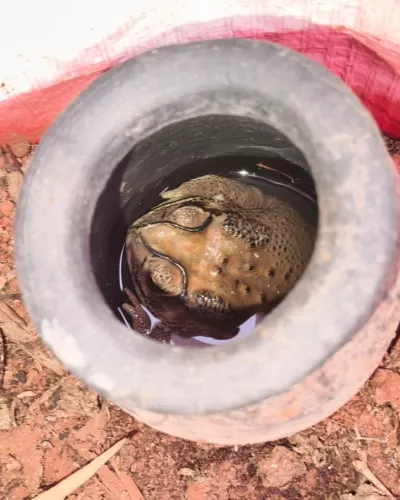
We found this toad sitting in an olla that had been left open. Toads are good company in a garden, since they eat insects. But inside the olla it can get trapped, foul the water, or die there. If you find one, lift it out gently and put it somewhere shady and damp. Then close the lid.
Any cover works if it fully closes the mouth and shuts out light: the clay lid that comes with the olla, an upside-down terracotta saucer, or a flat stone. Don't worry about air. The clay walls breathe on their own. Lift the lid only to refill, and put it straight back.
Only plain water goes inside
An olla is not a feeding tube. Anything you add besides water leaves residue in the clay, and residue clogs the pores.
- Soap and detergent. Never wash an olla with soap. It soaks into the clay, leaves a film, and later seeps out right where the roots are thickest.
- Liquid fertilizers and homemade brews. Jeevamrutha, kitchen-waste liquids, compost teas and bottled fertilizers all carry fine particles and sugars. These feed a slimy layer of bacteria and fungi on the inside wall. Within a few weeks the olla empties much more slowly. A closed olla also gets little air, so the liquid can go bad and smell like sewage.
- Strong feeds near roots. Roots crowd around the olla because that is where the water is. A strong liquid seeping out there can scorch them.
Feed the soil from the top instead. Pour any liquid feed onto the soil surface, under the mulch, and keep the olla for plain water. Rainwater or ordinary tap water both work.
If your olla turns slimy or slow
The sign is simple: the olla takes noticeably longer to empty than it used to, or the water smells or looks green. You can usually clean it without lifting it out.
- Empty it. Scoop or sponge out the old water. Don't tip the bag.
- Scrub the inside. Use a stiff bottle brush or a coconut-coir scrubber and plain water. No soap.
- Rinse and refill. Fill with clean water, swirl, scoop it out, then fill again for real.
- Put the lid back on. If the slime came from light getting in, find out how and fix the cover.
Between crops, when the bag is being refreshed, you can lift the olla out for a deeper clean. Scrub it inside and out, then leave it to dry in full sun for a day. Sunlight and drying kill what is left in the clay. Bury it again up to its neck, with mulch around it so only the lid shows.
Olla care at a glance
| Do | Don't |
|---|---|
| Keep a lid or cap on at all times | Leave the mouth open, even for a day |
| Fill with plain rainwater or tap water | Add soap, liquid fertilizer or homemade brews |
| Look inside before you refill | Pour water over a toad or other visitor |
| Scrub with a brush and plain water when it slows | Wash it with detergent |
| Keep mulch around it so only the lid shows | Let the clay wall stand bare in the sun |
Cover it, fill it with water, and leave it alone. That is the whole job.
The olla is one of the four pillars of the Nabhi method. Read what an olla is and how it works, or choose a plant that arrives with its olla already in place.