What is an olla? A 2,000-year-old way to water
An olla is an unglazed clay pot buried in the soil beside a plant, with only its neck above the surface. You fill it with water and put the lid on. The water seeps out through the clay, slowly, right where the roots are.
It is one of the simplest ways ever devised to water a plant, and one of the oldest. It is also the heart of every Nabhi bag we make.
An idea more than 2,000 years old
Buried clay pot irrigation is described in the Fan Sheng-chih Shu, an agricultural book written in China more than 2,000 years ago, and it was likely in use for a long time before that (Sunset). The method has hardly changed since.
It is being revived closer to home too. In drought-prone Raichur district in north Karnataka, farmers working with the Bengaluru organisations Prarambha and WELL Labs bury porous clay pots in their fields to water their crops. WELL Labs reports water savings of about 30 to 40 percent compared with drip irrigation (Gaon Connection).
How an olla works
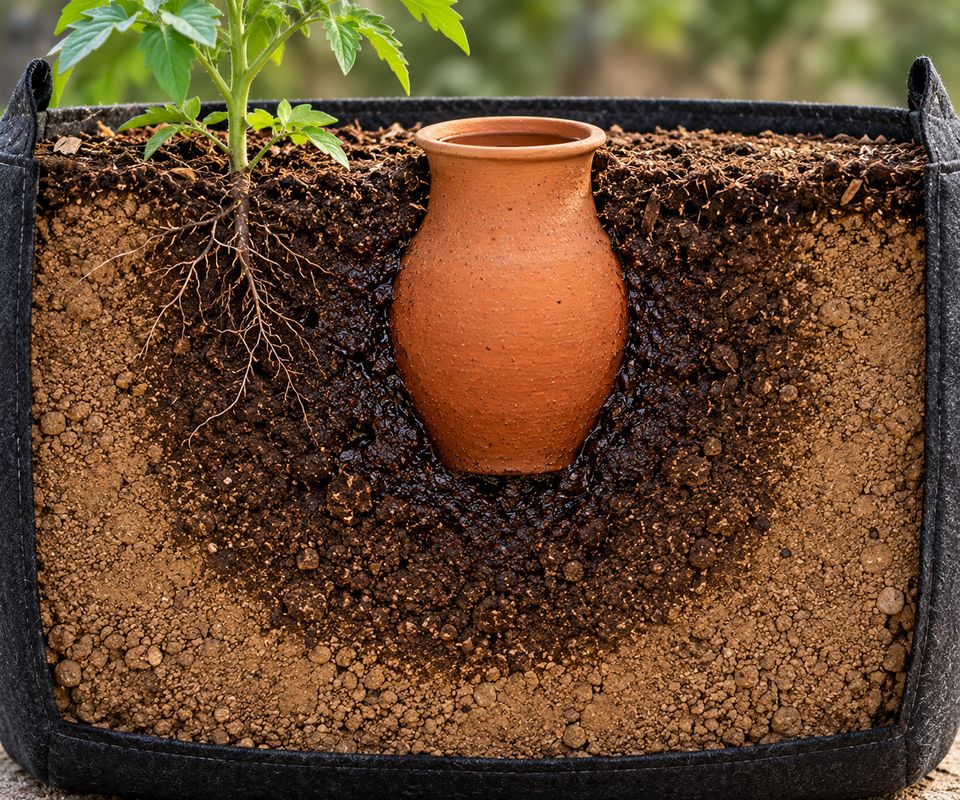
Unglazed clay is full of tiny pores. Water inside the olla moves through them towards whatever is drier on the outside.
When the soil around the olla is dry, it pulls water through the clay quickly. When the soil is already moist, the pull weakens and the water barely moves. So the olla releases water at the rate the soil, and the roots in it, actually use it. Nobody has to decide how much or when.
This is why you cannot overwater a plant through an olla. And because the water is released underground, at root level, very little is lost to the sun and wind at the surface.
Roots learn this quickly. Over time they grow towards the moist clay and wrap around it, so the plant is drinking right at the source.
Our ollas, made in Gudibande
Every olla in a Nabhi bag is made by a potter in Gudibande, close to our farm. He had never made an olla before we started. I worked beside him as he made the first ones, guiding the shape and the clay until they were right.
Our ollas are shaped like a vase that tapers towards the bottom, with a lid on top, and hold 2 to 3 litres of water. The narrow lower end sits deep among the roots; the lid keeps out leaves, insects and mosquitoes, and slows evaporation.
Before an olla goes into a bag, we fill it and leave it for at least 48 hours. One that leaks is set aside. Only ollas that pass go into a Nabhi bag.
Living with an olla
There is very little to do.
- Refill it when it runs low. Lift the lid, look, and top it up. How often depends on the heat, the humidity and where the bag stands.
- Keep the lid on. It keeps the water clean and stops mosquitoes breeding.
- Put only water in it. No fertiliser, no jeevamrutha, nothing else. Plain water keeps the pores open, and an olla that has only ever held water never needs cleaning.
- Expect it to sweat, not leak. Damp clay and a slow fall in the water level are the olla working. Water running out fast, or a visible crack, means something is wrong; tell us.
Can I add an olla to my existing grow bag?
You can try, and it may help your plant drink more evenly. But it will not turn your bag into a Nabhi bag.
The olla is one of four pillars. A Nabhi bag is built from the bottom up around it: an aged-wood hugel base, a living potting mix of hot compost and forest microorganisms, and a crown of slow-rotting mulch. Each part does a job the olla cannot, and the plant spends at least a week in the bag learning to feed from it before it reaches you. A bag that is already full of soil cannot be rebuilt that way.
We also do not sell ollas on their own. Our potter makes them by hand, and every olla he makes goes into a Nabhi bag. That is the point: we are not here to trade pots, but to hand you a plant that takes care of itself.
Read how the whole bag fits together in the Nabhi method, or choose a plant.